Potholes Shouldn't Have a Party: How Road Repair Got Tangled Up in Iowa's Culture Wars
Photo: simplenation, CC BY-SA 2.0, via Wikimedia Commons
A Busted Axle Shouldn't Be a Political Statement
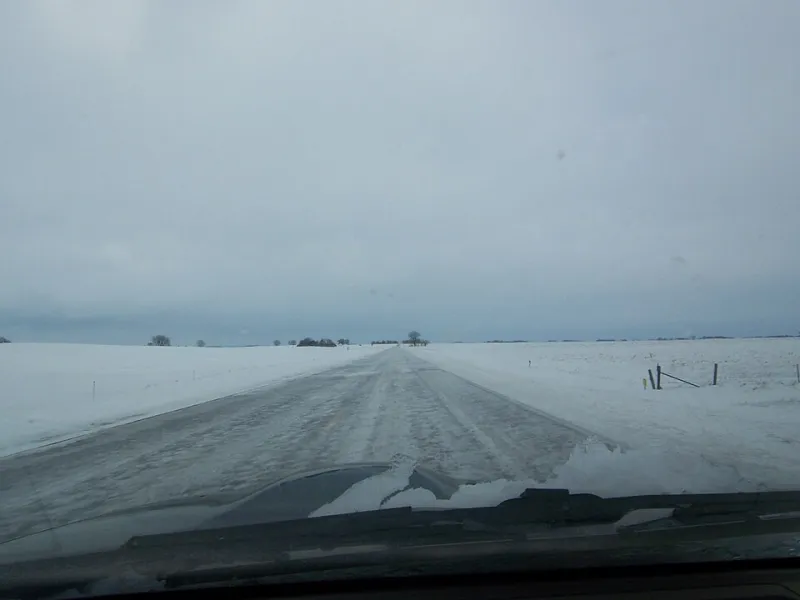
Drive down County Road F46 outside of Guthrie Center on a rainy Tuesday and you'll understand the problem pretty fast. The frost heaves from last winter haven't been patched. The gravel shoulder has crept into the lane. A hand-painted sign near the ditch reads, simply, "FIX THE ROADS."
Nobody put a party label on that sign. Nobody needed to.
For most of Iowa's history, local road maintenance occupied a comfortable, boring corner of government where Republicans and Democrats more or less agreed: roads need to be drivable, money needs to be budgeted, and the county engineer figures out the rest. It wasn't glamorous work. It wasn't ideological. It was just what local government did.
Something shifted. Over the past several years, infrastructure spending—even at the hyper-local level—has started picking up the static of national political arguments. Funding sources get questioned based on where the money came from. Projects get delayed because they're associated with an administration someone doesn't like. County supervisors who used to argue about asphalt grades are now arguing about whether accepting certain federal dollars amounts to a political endorsement.
The roads, meanwhile, keep cracking.
How Did We Get Here?
It's worth being honest about the mechanics of this problem, because it didn't come from nowhere.
Part of it traces back to how infrastructure funding has become bundled with broader legislative packages at the state and federal level. When the federal Infrastructure Investment and Jobs Act passed in 2021, it became a political football almost immediately—celebrated by some Iowa officials, treated with suspicion by others, even when the money was earmarked for things as unsexy as culvert replacements and bridge inspections. Local officials found themselves in an awkward position: turn down money their county genuinely needed, or accept it and deal with constituent blowback from people who'd decided the whole thing was a trojan horse for something else.
In Decatur County, a supervisor who asked not to be named described a public meeting where a straightforward road resurfacing proposal—funded through a mix of local property taxes and state allocations—got derailed by questions that had nothing to do with the road. "People were asking about where the money was really coming from, whether it was tied to some agenda," he said. "We're talking about a mile and a half of blacktop. It shouldn't take three meetings."
This isn't unique to one county or one political flavor. In more urban-leaning areas, infrastructure projects have sometimes stalled over disagreements about equity and prioritization—legitimate concerns in principle, but occasionally weaponized in ways that freeze decision-making. In more rural conservative areas, federal or state involvement in local projects has become a symbolic flashpoint even when the practical case for the project is airtight.
The result is the same either way: delayed projects, higher costs from those delays, and a public that grows increasingly cynical about whether local government can do anything right.
The Officials Trying to Pump the Brakes
Not everyone has given in to the dysfunction. Across Iowa, there's a quiet cohort of county engineers, city administrators, and township trustees who are essentially trying to rebuild a firewall between basic infrastructure maintenance and political theater.
In Poweshiek County, County Engineer Dale Helmuth has developed what he half-jokingly calls a "just the facts" presentation style for public meetings. Before any road project discussion, his office distributes a one-page sheet with nothing but the physical data: pavement condition index scores, traffic counts, estimated cost per mile to repair now versus later, and projected lifespan of different treatment options. No commentary. No framing. Just numbers.
"Once people are looking at the same facts, it's a lot harder to make it about something else," Helmuth said. "A road with a PCI of 38 needs work. That's not a Republican road or a Democrat road. It's a bad road."
In Grundy County, the city of Grundy Center has experimented with a community infrastructure priority survey—a simple online and paper form that lets residents rank their maintenance concerns without any funding source information attached. The idea is to establish what people actually want fixed before any conversation about how to pay for it. City Administrator Matt Dobbe said the approach has helped depoliticize early-stage conversations. "When we know the community wants the east side streets done first, that's the mandate. Then we figure out the money. It keeps the politics from getting ahead of the need."
The Real Cost of Delay
Here's something worth sitting with: the American Society of Civil Engineers estimates that every dollar of deferred road maintenance eventually costs four to five dollars to fix later. Iowa's road funding challenges are real and documented—the Iowa Department of Transportation has flagged hundreds of bridges statewide as structurally deficient, and rural county budgets have been squeezed for years.
When political conflict delays a project by even one construction season, the cost goes up. When a county spends three extra meetings arguing about the ideological implications of a resurfacing grant, that's staff time and legal review time that comes out of a budget that's already stretched thin.
This is the part that tends to cut through when you say it plainly to almost any Iowa voter, regardless of where they fall on the political spectrum: we are literally paying more money to have worse roads because we can't stop fighting about things that have nothing to do with roads.
A Framework for Getting Back to Basics
So what actually works? Based on conversations with local officials across the state, a few approaches seem to consistently help communities get unstuck.
Lead with the physical reality. Before any funding conversation, establish what condition the infrastructure is actually in. Pavement ratings, bridge inspection reports, and maintenance backlogs are public records. Make them visible and readable.
Separate the need from the source. The question of whether a road needs repair is distinct from the question of where repair money comes from. Tackle them in that order. Once a community agrees something needs fixing, the funding conversation is more practical and less political.
Invite people into the boring details. Nothing deflates political theater faster than a genuine deep dive into specifics. Invite skeptics to walk a project site with the county engineer. Host a meeting that's just about how road condition ratings work. Boredom, in this context, is a feature.
Name the cost of delay explicitly. When a project gets pushed back for political reasons, calculate what that delay will cost and say it out loud in public meetings. Accountability to a real dollar figure has a way of refocusing conversations.
None of this is revolutionary. Most of it is just common sense—which, not coincidentally, is what Iowans have generally been pretty good at when they're not being pulled in opposite directions by forces that have no interest in whether County Road F46 ever gets patched.
The pothole doesn't care who you voted for. It'll take out your front end either way.