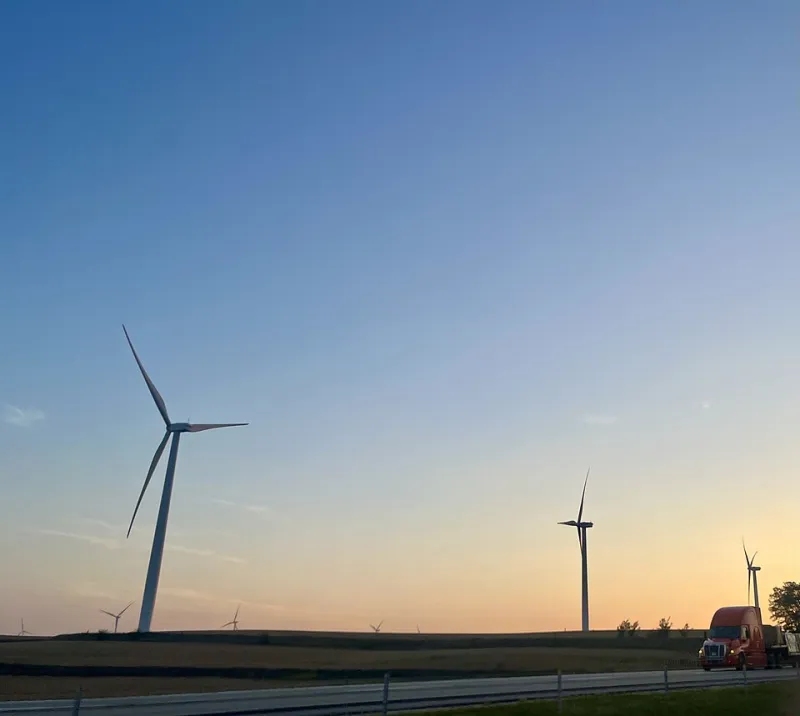
Profit and Prairie: Why Iowa's Sharpest Business Minds Are Betting Big on Clean Energy
Photo: GoBlue9, CC BY-SA 4.0, via Wikimedia Commons
Strange Bedfellows at the Bargaining Table
Not long ago, the idea of a grain elevator operator and a Sierra Club chapter sharing a conference room without a mediator would have seemed like a punchline. But walk into enough Iowa Chamber of Commerce meetings lately, and you'll find exactly that. Farmers, manufacturers, small business owners, and environmental nonprofits are sitting down together—not because anyone told them to, but because the math started making sense.
Iowa already generates more than 60 percent of its electricity from wind power, a figure that leads the entire nation. That didn't happen by accident, and it didn't happen because everyone agreed on climate science. It happened because wind turbines generate lease income for landowners, because energy costs for manufacturers dropped, and because rural counties started collecting serious property tax revenue from wind installations. In short, it happened because people followed the money.
Now solar is following the same path, and a new wave of cross-aisle collaboration is emerging to meet it.
What Changed the Conversation
For years, renewable energy in Iowa was treated like a political football. Conservatives worried about grid reliability and the optics of anything that smelled like a green agenda. Progressives pushed hard on climate but sometimes struggled to connect those arguments to the immediate concerns of a hog farmer watching his input costs climb.
The shift came gradually, driven less by persuasion than by circumstance. Energy prices spiked. Supply chain disruptions hit manufacturers hard. And solar panel costs dropped so dramatically that the return-on-investment timeline shrank from decades to years. Suddenly, the conversation stopped being about ideology and started being about operating budgets.
Take the example of small manufacturers in the Iowa River corridor who began exploring solar co-ops—shared installations that let businesses too small to build their own arrays lock in stable electricity rates. Conservation groups like the Iowa Environmental Council, which had spent years trying to make the environmental case, found themselves fielding calls from business associations asking about grant programs and net metering rules. The environmental groups had the technical knowledge. The business groups had the membership networks and the political relationships. The partnership practically wrote itself.
Grain Bins and Solar Panels
Out in western Iowa, agricultural co-ops are starting to look at their sprawling rooftops differently. A grain co-op sitting on 40,000 square feet of south-facing metal roof has an asset most solar developers would love to work with. When co-op managers started running the numbers on what they were spending on electricity to run dryers, augers, and climate-controlled storage, the conversation with solar installers got serious fast.
Local installers—many of them Iowa-based small businesses themselves—have been the connective tissue in a lot of these deals. They're not selling an environmental vision. They're selling a 15-year payback on a capital investment, a hedge against rate increases, and a selling point for co-ops trying to attract younger farmer-members who care about sustainability. It's practical. It's Iowan.
Conservation organizations have adapted their pitch accordingly. Rather than leading with carbon emissions, many are now walking into meetings with spreadsheets. They're talking about energy independence, rural economic development, and the fact that dollars spent on locally generated power tend to stay in the community rather than flowing out to distant utilities.
The Policy Piece Nobody Talks About Enough
Here's where it gets genuinely interesting for anyone who follows Iowa politics. This ground-level collaboration is starting to influence the statehouse in ways that neither traditional business lobbying nor environmental advocacy could manage alone.
When a business association and an environmental nonprofit show up to a legislative committee hearing with the same ask—say, expanding net metering caps or streamlining permitting for community solar projects—legislators who might dismiss one group find it harder to dismiss both. The coalition doesn't have to agree on everything. They just have to agree on the specific policy in front of them.
That's a model worth paying attention to. Iowa's political culture has always had a pragmatic streak underneath the partisan noise. People here generally respect someone who shows their work, who can point to a real project in a real county that created real jobs. When that evidence comes from a coalition that includes both the local business development corporation and the county conservation board, it carries weight.
What's Still Hard
None of this is frictionless. Trust takes time to build, and there are real disagreements lurking beneath the surface of these partnerships. Some business owners remain skeptical of environmental organizations' broader agendas. Some conservationists worry that a laser focus on economic arguments lets policymakers off the hook for addressing the deeper environmental issues at stake.
Grid infrastructure is a legitimate sticking point. Iowa's transmission network wasn't designed for the distributed generation model that solar co-ops and farm-based installations require, and upgrading it costs real money that somebody has to pay. Figuring out who bears that cost—utilities, developers, ratepayers, or some combination—is a genuinely complicated policy question that doesn't resolve neatly just because business and environmental groups are friendlier than they used to be.
And there's the perennial Iowa challenge of scale. A solar co-op that works beautifully for a cluster of businesses in Story County doesn't automatically translate to a sparsely populated county in the northwest corner of the state. Solutions that work in Iowa City don't always work in Ida Grove.
The Bigger Lesson
What's unfolding across Iowa with renewable energy isn't really a story about solar panels or wind turbines. It's a story about what happens when people stop waiting for Washington to hand them a solution and start building one from the materials at hand—shared economic interest, local relationships, and a willingness to sit across from someone you don't entirely agree with.
Iowa has always been pretty good at that, when it decides to be. The farmers who built the co-op system understood that you could accomplish more together than apart, even when you disagreed about plenty of other things. The folks now quietly stitching together clean energy partnerships across the state are working from the same basic playbook.
It's not glamorous. There's no viral moment, no dramatic Senate floor speech. It's just Iowans deciding that a problem worth solving is worth solving together—and that the bottom line and the common good aren't always as far apart as the loudest voices want you to believe.