Snowdrifts and Common Ground: The Iowa Towns That Let Winter Do the Hard Work
When the Weather Doesn't Care About Your Politics
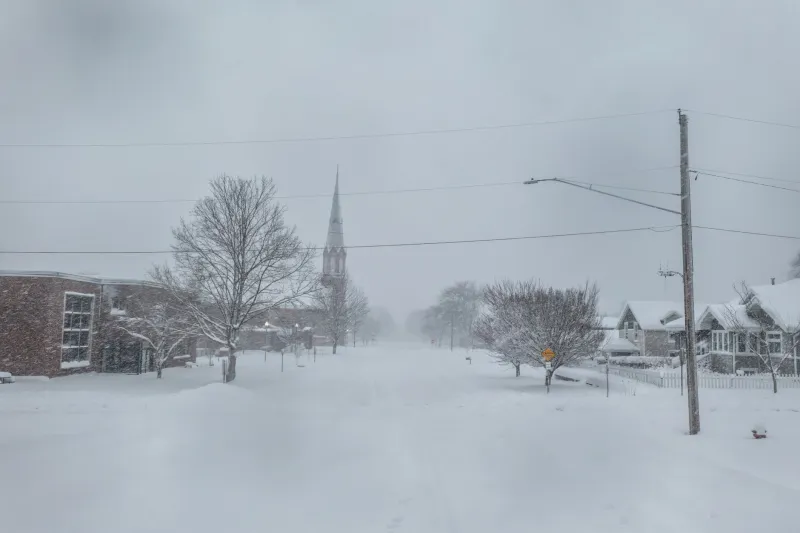
There's something clarifying about a February ice storm. The roads don't discriminate. The furnace doesn't check your party registration before it quits. And when the county's one working snowplow needs a $14,000 repair nobody budgeted for, the argument about whether the town supervisor is a socialist or a RINO tends to take a back seat pretty fast.
That's the dynamic a growing number of Iowa communities are leaning into—deliberately. Not by staging feel-good forums or hiring consultants to facilitate "dialogue," but by sitting people down around an actual problem: How do we get through winter together, and what does that take?
The answers, it turns out, have a way of spilling over into everything else.
Grundy Center's Accidental Experiment
It started, as a lot of things in small-town Iowa do, with a busted piece of equipment and not enough money to fix it.
Grundy Center had been running a single aging brine spreader to pre-treat its roads before major winter storms. When it went down two winters ago, city staff scrambled to figure out a workaround. Somebody suggested reaching out to the county highway department. Somebody else suggested calling a neighboring township that had newer equipment sitting idle half the season.
What followed was a series of meetings that brought together city council members, county supervisors, township trustees, and a handful of local business owners who were frankly tired of watching their parking lots turn into skating rinks. The group was, politically speaking, a mixed bag. A couple of vocal conservatives, a few reliably progressive voices, and a whole lot of people who'd rather not be labeled either way.
They worked out an equipment-sharing agreement. Simple enough. But then someone said, "As long as we're all here, can we talk about the shelter situation?" Meaning: what happens if a storm traps residents who don't have heat?
That conversation led to another. And another. By spring, Grundy Center had a newly formalized emergency preparedness committee that meets quarterly—and a communication network that didn't exist before.
"We didn't set out to fix anything except the brine spreader," admitted one city council member who asked not to be named because, she said, "I don't want this to sound like a political story. It isn't one."
That's kind of the point.
The Psychology of Shared Inconvenience
Community organizers and local government researchers have a name for what's happening in places like Grundy Center, though the academic framing is a lot less interesting than the reality. The idea is that shared adversity—especially the kind that's concrete, immediate, and apolitical in origin—lowers the social barriers that usually keep people in their corners.
A blizzard is not a culture war issue. Salt supplies are not a partisan flashpoint. Whether the township's emergency contact list is up to date affects everybody the same way, regardless of what their yard signs said last November.
That's the opening. And the towns that are making the most of it aren't waiting for the crisis to do all the work—they're using the crisis as a reason to convene, and then making sure the conversation has somewhere to go.
In Pocahontas County, the emergency management coordinator started holding pre-season winter readiness meetings three years ago. Attendance was modest at first—a few fire chiefs, the highway department, a couple of city clerks. But she opened the meetings to the public and started advertising them through church bulletins and the local co-op newsletter, not just government channels.
Now they draw 40 to 60 people on a good night. Topics have drifted from road salt inventories to volunteer coordination to, yes, what to do about the one county shelter that's been operating out of a building with a failing roof for the better part of a decade.
"People come in talking about snowplows and they leave talking about infrastructure," she said. "I don't think that's an accident."
Keeping the Momentum Past Mud Season
The harder challenge isn't getting people to show up in January. It's keeping them engaged in June.
Some towns are managing it by treating the winter planning process as the foundation for a broader civic calendar—using the relationships built around emergency prep to tackle questions that are thornier and less immediately urgent. Watershed management. Broadband access. Consolidating services across jurisdictions that have historically been territorial about their turf.
In one northeast Iowa county, a group that came together to coordinate emergency warming centers during an especially brutal stretch two winters ago has since taken on a project to map volunteer resources across a six-township area. The map didn't exist before. Nobody had sat in the same room long enough to build it.
"The winter stuff got us comfortable with each other," said a township trustee involved in the effort. "Once you've solved a real problem with somebody, it's easier to try solving the next one."
That's not a revolutionary insight. But it's one that a lot of communities have forgotten in an era when the easiest thing to do is retreat to your own corner of the internet and assume everyone on the other side of town is an idiot.
What Other Towns Can Steal From This
You don't need a broken brine spreader to start. What you need is a practical question that affects everyone and doesn't have an obvious partisan answer.
Winter planning is a good one because the stakes are real and the timeline is fixed. You can't put off a snowstorm. You can put off a zoning debate for years. That urgency is a feature, not a bug.
A few things the towns making this work seem to have in common:
They start with logistics, not values. Nobody walks in expecting to agree on everything. They walk in expecting to figure out who has the extra road salt and who needs it. That's a manageable goal.
They invite people through trusted local channels. Church bulletins. Co-op newsletters. The guy at the feed store who knows everybody. Not a press release.
They let the agenda breathe. The best conversations tend to happen when someone says "while we're here" and the facilitator doesn't shut it down.
They follow up. The towns where this fizzles are usually the ones where the meeting happens, people feel good about it, and then nothing gets written down or assigned.
Spring Is Coming. The Question Is What You Built.
Iowa winters are long enough to do real work if you use the time right. The towns that are figuring this out aren't doing anything fancy. They're just refusing to let the season be an excuse to hunker down and wait it out alone.
The snow will melt. The roads will dry out. But the relationships, the shared contact lists, the muscle memory of sitting across a table from your neighbor and solving something together—that stuff sticks around.
And in a state where a lot of communities are quietly wondering whether they still know how to talk to each other, that's not nothing. That might actually be everything.